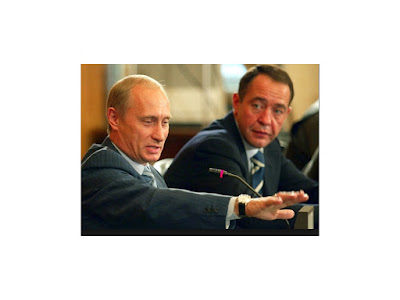
 Photo Credit: thetimes.co.uk
DC police seem oddly confused about the death in a hotel room in Washington, DC, in November of prominent Kremlin insider, Mikhail Lesin. Police have provided little detail other than the death was related to, a result of, or unrelated to extensive blunt force trauma over large parts of his body. The cause of death, “undetermined”. An investigation--such as it is--is ongoing.
Mikhail Lesin was Putin’s press minister (a post as Orwellian as you might guess) and Putin aide who helped shape Putin’s macho political image to appeal to the Russian electorate. Lesin built the English language news service Russia Today (RT) and used it to serve the propaganda needs of the Kremlin. Known as the “Bulldozer”, he aggressively went after independent news services critical of the Kremlin and closed them down.
Although he worked much of his career as a civil servant, Lesin was immensely wealthy.
He bought $28m in real estate in Los Angeles and owned a US$50m mega-yacht
News.com/au.
He was also reported to have property in Europe and the British Virgin Islands.
As with many improbably wealthy Russians residing in the West, the origins of Lesin’s immense wealth was unexplained.
The circumstances of Lesin’s death are equally poorly understood. What is known is that Lesin was found dead in his hotel room at the Dupont Circle Hotel shortly before noon on November 5, 2015. DC police and the DC Medical Examiner briefly reported four months later on March 10 that Lesin’s cause of death was “blunt force injuries of the head” and that he also suffered “blunt force injuries of the neck, torso, upper extremities and lower extremities.” However, the DC Medical Examiner also states that the manner of death is “undetermined”; in other words, they don’t know how he got those injuries. DC police have said that their investigation is still open but they have provided no additional details.
News reports are as short on facts as the DC Medical Examiner.
An article in the
Washington Post newspaper can best be described as a mélange of isolated facts and speculation.
The Washington Post reports that police claim Lesin showed up at the Four Seasons hotel drunk one night in early November and was turned away from the bar.
He is then said to have checked out of the Four Seasons, where he had been staying, and checked into the Dupont Circle Hotel, where he was found dead on November 5th.
Only The Washington Post seems to be aware that Lesin stayed at the Four Seasons.
No other news service has reported this.
If true, though, it undermines speculation that Lesin was staying at the modest Dupont Circle Hotel in order to keep a low profile.
The Washington Post does not explore why Lesin checked out of the Four Seasons hotel or why he chose the Dupont Circle Hotel to check into. There are any number of higher end hotels closer to the Four Seasons.
The Washington Post doesn’t explore why the Dupont Circle hotel would check in a guest so drunk he was tossed out of the Four Seasons bar, or how Lesin managed to get to Dupont Circle in his condition.
The Washington Post reports police speculation that Lesin may have been injured in a brawl or was hit by a car, but does not explore how then Lesin’s condition did not attract the attention of the Dupont Circle Hotel front desk when he checked in. The Dupont Circle Hotel’s discretion must be exemplary.
The brawl theory seems a red herring, though.
The neighborhoods around the Four Seasons and Dupont Circle, where most embassies are located, are upscale and heavily policed.
A serious brawl would have attracted immediate attention.
The streets are also heavily traveled.
Someone getting hit by a car would also attract immediate attention.
According to police, they just don’t know.
The
New York Times reports that Lesin arrived at the Dupont Circle Hotel “disheveled” but without apparent injuries, leaving one to wonder if Lesin didn’t acquire his extensive injuries after arriving at the hotel.
The Washington Post goes on to say that a Russian television station reported that Lesin had been with friends before his death. How his friends disappeared so completely or, if there had been a fight or a car accident, why they were not there to help him with his injuries is not explored.
The Washington Post reports that a certain long-term friend of Lesin’s in Russia, Sergey Vasiliev, believes Lesin died from heavy drinking, which is what Vasiliev says he was told by the Russian Foreign Ministry.
This is the same Foreign Ministry that is complaining that they do not have any information and are demanding to be briefed by US authorities.
The
BBC reports that the Russian embassy in Washington told them it only became aware of Lesin’s injuries when the DC medical examiner’s report was released.
The BBC reports that the Russian embassy press secretary criticized the lack of communication by US authorities,
“saying Russia had made repeated requests for updates on the investigation but very few facts had been given.”
A number of news sources report an unspecified long-term illness, inferring that the illness may have had something to do with Lesin’s death. The BBC quotes the head of Russian media regulator, Rosepechat, as saying that Lesin had had spinal surgery but was in good health. The inference seems a highly doubtful explanation for Lesin’s death.
The only sensible comment out of Russia seems to be a BBC quote from Lente.ru from a Russian forensic expert that Lesin’s injuries “were consistent with a severe beating, not an accident or the result of convulsions”.
The Washington Post reports that the same Vasiliev claimed that on November 4 a hotel guard at Dupont Circle checked on Lesin because he had failed to come out of his room for a long time. However, according to The Washington Post, Lesin had only just checked in, so he could hardly have been there for a long time. Vasiliev claims Lesin was found dead the next morning by the hotel maid, although The Washington Post can’t say because the hotel declined to comment when asked by them.
Vasiliev also claimed that Lesin had had breakdowns and drinking bouts in the past and had sometimes fallen and injured himself. Who is Sergey Vasiliev? Take your pick. There are many on the web, though none are an obvious candidate. The Washington Post does not provide enough information to identify Sergey Vasiliev. [NB; subsequent news reports identify Sergey Vasiliev as CEO of VI Group, a Moscow advertising media company. However, assertions by the improbably well-informed Vasiliev beg corroboration.)
Did the Kremlin kill Lesin?
The Moscow Times reports that Lesin had had a falling out with another Kremlin insider, Yuri Kovalchuk, a major shareholder of Gazprom Media, where Lesin most recently worked.
Reportedly Lesin owed Kovalchuk a large sum of money that he did not intend to pay back.
TheDailyBeast (and
TheDailyBeast2) reports that Lesin owed money to “some of the most powerful men in Russian media and finance.”
If the Kremlin is involved though, it is loosing its touch. This murder will be tough for the Kremlin to pin on rogue Chechens or accidental poisoning by rare radioactive isotope that the victim had lying around the house, as the Kremlin has claimed about other Russians who fell foul of Putin and died in unusual circumstances. Blunt force trauma lacks finesse and is kind of hard to explain away. All one can say is that the mortality rate among not only Kremlin critics but also Kremlin supporters is high.
The police are oddly reticent to call Lesin’s beating a crime. Even if it were an ordinary drunken bar fight, possibly with friends who were supposedly accompanying Lesin, he is dead, and that is still at least manslaughter. The only reason to tread carefully is if those who beat Lesin were powerful men (really, no pun intended) or connected to the Russian embassy and had diplomatic immunity; without compelling evidence, even to make the accusation could escalate to a major diplomatic confrontation. That the Russian embassy in DC feigns complete ignorance while some in Russia share detailed information, suggests that the Kremlin wishes to distance itself from Lesin’s death or someone is engaged in obfuscating the truth. But that is all just speculation on my part.
In an otherwise fantastical article, the
Pro Russia News service, helpfully posts images of the original death notice for Lesin issued on November 7, 2015, and the Chief Medical Examiner’s statement on March 10, which contain curious errors.
PRN notes the seemingly hastily prepared nature of the March 10 notice that misspelled the title of the Chief Communications Officer, had no date, and did not provide the names of the Chief Medical Officer or the Chief of Police in whose names it was issued.
The
New York Times reports that
the “medical examiner’s office did not explain the timing of its announcement, nor why the findings took so long. Officials there had said as recently as Wednesday that it would not imminently release its findings, only to reverse course the next day.” The rest of the PRN article is complete nonsense.
There are other anomalies. Lesin was discovered dead around mid-day on November 5. Within hours Russian news services were reporting his death and that, according to family members, he had died of a heart attack. That the family may have been informed of his death so quickly seems possible, but why Russian news services? And on what basis did the family believe Lesin had died from a heart attack? Is the connection that Lesin’s daughter works for the US bureau of Russia Today (RT), the news service that her father had set up?
Lesin’s family is surprisingly quiet.
His son, Anton Lessine, is a financier and film producer in Los Angeles.
Lesin’s daughter, Yekaterina Lessina (or Ekaterina Lesina) also lives in Los Angeles.
Both live far beyond their incomes in houses that were purchased by their father.
Lesin is said to have provided tens of millions of dollars to fund his son’s business interests and may have been involved in the business himself (Margarita Simonyan, RT editor in Moscow, claims Lesin invited her to come to Hollywood to write screen plays and he would act as her producer,
Radio Free Europe).
Business Insider.
One reason to be quiet is that, as direct beneficiaries of their father’s alleged corruption, they may be subject to criminal charges and penalties also, such as confiscation of their properties, threatening the pampered lifestyle of both children.
Despite a lack of evidence from the US Justice Department of an active investigation,
TheDailyBeast reports,
“it was all but certain that he [Lesin] was being pursued by US law enforcement” and
“the FBI had enough evidence to consider opening a case.” Dicey stuff for recipients of allegedly ill-gotten gains.
Ekaterina Lesina is the daughter of powerful Russian media mogul Mikhail Lesin, who is one of Vladimir Putin's top advisers and the former Kremlin media chief.
In summer 2014, a scandal arose when an otherwise mundane lawsuit revealed that Lesin had secretly purchased three multi-million dollar mansions in Los Angeles (one for himself, one for his son Anton Lessine, and one for Ekaterina) at a cost of nearly $30 million. He and his family also purchased at least 8 luxury vehicles, at a cost of more than $1 million, including a $250k Bentley and a $300k Ferrari.
It was also revealed that Lisin had invested tens of millions of dollars through anonymous corporations into the production of Hollywood blockbusters, including the Brad Pitt thriller "The Fury".
Following the emergence of these details, Mississippi Senator Roger Wicker called for the Department of Justice to investigate whether Lesin's money was being illegally laundered in the US and/or was generated via government corruption.
The original lawsuit was the result of two former nannies suing Carole Lessine (Ekaterina's sister-in-law) over wrongful termination and abuse.
Ekaterina's house is located in the exclusive gated community of Mulholland Estates and was purchased for $5.6 million. Her brother's mansion in Brentwood and her father's estate in nearby Beverly Park are also featured on this site.
The theory that Lesin was in Washington to cut a deal with the US seems though to be largely based on his staying at the low profile Dupont Circle Hotel. However, The Washington Post’s claim that he was actually staying first at the very high profile Four Seasons pretty much blows that theory out of the water. In any case, The Washington Post also reports that Lesin was in town to attend a charity function honoring Pyotr Aven, a Russian billionaire and philanthropist for which he had paid $10,000 for a dinner ticket, not a good way to keep a low profile.
In some sense, the Kremlin turning on its own people, if true, is comforting. It means less attention on others. The Kremlin is showing strains, and Putin’s affection for Stalin extends to Stalin’s methods and climate of paranoia. Those still in the Kremlin’s favor need to be careful. It is so easy to fall out of Putin’s good will. Might Vladimir Yakunin, former head of Russian Railways, or Herman Gref, CEO and Chair of Sberbank, Russia’s largest bank, who have spoken out recently about problems in Russia, be next? Or, Arkady Rotenburg, if that bridge to Crimea doesn’t work out? In good stead today doesn’t mean waking up in good stead tomorrow—or waking up at all. It just takes a twitch to fall out of line with Putin, also a Stalin characteristic.
What should concern Americans is the work of the DC police and the medical examiner. So far, they appear either evasive or ineffectual. Lack of progress leaves the impression that Russian oligarchs are treated as “hands-off,” which everywhere else has emboldened their criminal behavior. A body is a body. It was either homicide or manslaughter. What it is not is just those madcap Russians having fun on holiday.
A rogue Russia reaching out to murder its citizens in the United States and other countries, as well as conducting subversive acts including military aggression is a threat to everyone.
It has been months since Mikhail Lesin’s death but the DC police have only now released a brief, inconclusive description of what they know.
The case echoes the British government’s treatment of the
Litvinenko murder, which was investigated only after Litvinenko’s wife get a court order for a public inquiry.
Not only are the DC police less than impressive in pursuing and making public the essential facts of Lesin’s death, US law enforcement appears derelict in pursuing obvious instances of money laundering by Russian citizens and their families, including Lesin, who establish themselves in legitimate enterprises in the US to “launder” criminal gains, which only facilitates the dangerous conduct of a rogue state with an unstable leadership that is capable of far greater harm.
Dirk Mattheisen is a writer and blogger on political economy with a focus on European affairs. He is also an independent consultant on institutional governance of international economic and financial institutions. Dirk Mattheisen is a former Assistant Corporate Secretary of The World Bank Group.


