Putin’s latest election dirty tactic: Label the opposition as ‘foreign agents’


November 20, 2020 at 4:35 p.m. EST

 |
| Photo Credit: NYTimes |
It is tough to deal with disinformation. It floods social media. It is meant to misguide, disrupt, and undermine fact and truth.
It's tough to have a plan or a strategy to counteract lies, especially when the lies come from or are given weight by a prominent public figure, such as President Trump.
The following is an excellent, practical, short case study for capturing the high ground and limiting the effectiveness of disinformation, courtesy of Alan Steele Bowser, a civil activist, attorney, and president of the Montgomery County Civic Federation outside Washington DC in Maryland. Alan's key points are (in his text below I have bolded key passages),
"...use the sandwich method:1) state the facts2) push back on the lie without repeating it3) return to fact-based, positive messaging"
What Alan writes echos what I wrote previously as I tracked down an online troll who had attempted to troll something I had written. I wrote in response then,
"The internet amplifies lies, but it also calls them out.
CASE STUDY
Stategy for Countering DisinformationNo matter where the disinformation Comes from.
[Quote follows]
THIS IS IMPORTANT INFORMATION FROM EXPERTS REGARDING THE DISINFORMATION CAMPAIGN BEING COORDINATED BY TRUMP:
It’s now abundantly clear that Donald Trump is leading a coordinated right-wing disinformation campaign to muster every legal, governmental, and communications tool in its arsenal to cast doubt on the validity of our elections and delegitimize Joe Biden’s presidency.
The experts are advising us to:
Project confidence across social media channels - amplify messages that support objective reality and tap into the public’s strong desire to move the country forward.
Continue a steady pressure campaign aimed at GOP lawmakers and government officials who are validating Trump’s lies - it’s working.
GENERAL MESSAGING GUIDELINES:
The message is simple: Voters Decided.
The best defense is a good offense - Take the higher ground and hold it. Amplify big, overarching themes. Base content on consistent, fact-based messaging. Elevate the everyday heroes: poll workers who kept locations running, voters who braved the pandemic to be heard, non-partisan election officials doing their jobs, and peaceful activists calling for our democratic process to be upheld.
Never amplify lies - Do not engage with or point to content, articles, or threads on social media that contain disinformation lies. Heightened engagement and traffic - regardless of who it's from and what it says - is rewarded by a platform's algorithms and will result in spreading the lie further. Be prepared to respond in private settings. Always be sure you’re citing trusted, verified sources.
If necessary to push back do it in an indirect way - If and when a clear tipping point has been reached and it becomes necessary to respond, use the sandwich method: 1) state the facts 2) push back on the lie without repeating it (e.g. “our opponents lost the election in Pennsylvania, so contesting the results by making false claims is all they have left...”) 3) return to fact-based, positive messaging. Aim to pivot the debate away from the negative lie, towards pro-democracy messaging.
Recommended hashtags:
#VotersDecided #TransitionNow
Message Recommendations:
The people have spoken - voters overwhelmingly chose Biden to move the country forward. #VotersDecided
Our new leaders are acting quickly to lead a government for the people to move the country forward and fix the crises created by the last Administration. #TransitionNow
Our legally mandated election process is moving forward as our founders intended. Voters have decided, and now all states will report official election results to Congress by December 8. #TransitionNow
SAMPLE TWEETS:
@JoeBiden and @SenKamalaHarris will be sworn in on Jan 20, 2021 - and they’re already rolling up their sleeves naming a COVID-19 advisory board and calling for Americans to protect themselves and each other by wearing masks! #VotersDecided
This weekend we celebrated #VotersDecided in the streets! Now our democracy moves forward - we’re going to swear in new leaders that stand for and protect the will of the people!
Our democracy stands strong - no matter what they tell you. We’ve had peaceful transitions of power through previous pandemics, the Great Depression, and World War II - this year is no different #VotersDecided
The Trump admin is legally required to begin the transition process now that @JoeBiden is the winner. @GSAEmily and other federal officials need to begin the legally mandated transition process now! It's irresponsible to stall as the pandemic rages on! #VotersDecided

Imagine for the moment genuine authoritarians, such as Russia’s Putin, China’s Xi Jinping, or North Korea’s Kim Jung-un, suffering what President Trump suffered in the debate, an open and bruising argument about how effectively he governs. He bullied and insulted and still Biden won because Biden did not simply fold. And, Biden conveyed at moments the qualities admired by an electorate in a democracy, including respect for the process, empathy, and common sense.
Imagine those same authoritarians waking up to the kind of punditry directed at Trump the next morning; imagine having to endure Joy Reid on MSNBC comment that,
“At this point, he’s an angry autocrat who’s desperate to hold on to power. And who sees the legal threat ahead of him. And the potential seizure of assets in his future. And the potential foreclosure of Trump Tower. And he’s mad. And he does not understand why he has to even sit through a debate or sit for an election.”
The firmly authoritarian states, Russia, China, North Korea, must wonder at the challenges to Trump’s authority and the indignity of the New York Times exposé of his finances that conjures a genuine risk of multiple prosecutions. They must wonder at the kind of vulnerability that could get a leader-for-life into a lot trouble; something like a Belarus, for instance.
Churchill famously said that “democracy is the worst form of government except for all those others that have been tried…”. He also said, “No one pretends that democracy is perfect or all wise”. And so it proved on Tuesday night. Sure, the tenor of debate was pathetic, and Trump disgraced the dignity of the office of the president not to mention the intelligence of the audience through a barrage of familiar lies. But what a demonstration of democracy’s power to hold its leaders to account through public scrutiny. The audience walked away with a good understanding of the character and caliber of each man. And what to make of the audience? American civil society includes roughly as many Trump supporters as those who oppose him. But for all his support the only collective of people that Trump could call to his banner was the extreme-right Proud Boys. The rest were those he would exclude. The next morning, even Trump’s Republican supporters kept their distance. In a true autocracy, the Putins, Xi Jinpings, and Kim Jung-uns can call on the security forces and military to uphold their power. America’s military leadership has made it clear they serve America, not one political side or the other, and, when deployed, federal law enforcement from a hodgepodge of agencies had to be withdrawn because of public outrage. For all the bluster, Trump cannot compel the outcome he desires.
The Gorgon-headed threats to Trump multiply because American democracy does not have a single center of power. It is distributed across co-equal branches of government, holding each other to account, including an independent judiciary, as well as state governments, a free press, and through citizen direct action. Points of view can not be imposed from above but have to be debated and reconciled through compromise. When there is an attempt to force a single view, democracy is an open process that exposes dysfunctional choices even when the path forward is fraught with uncertainty. Trump was exposed to public view as a badly damaged person and a populist hack appealing to the worst impulses in a divided civil society rather than as a conciliator and unifier.
The debate also shone with promise; as when challenger Biden said we need law and order, yes, but also justice. Justice is not just about the rule of law as expressed through the use of force but also about that peculiar American notion imbedded in the Constitution of the “pursuit of happiness”, reflected today in the idea of freedom of opportunity for all no matter their background or circumstance. Trump is failing because he offers nothing someone who enjoys or aspires to democracy’s freedoms could embrace. Here’s to the protesters in Portland (not the agitators but the citizens demanding better from society and from their government), the marchers in Washington DC, and the fact-checkers.
America’s autocrats, populist demagogues, and fringe hate groups—the Donald Trumps, Joseph McCarthys, the KKK and the Proud Boys--can make democracy “imperfect and unwise”, and Trump is a particular danger because of the central authority that the presidency holds, but the evidence on Tuesday night is that, in the face of push back, Trump does not control the process or the message. Time and again the tide has turned against the autocrats and hate mongers. Democracy is alive and well in the distributed power of the People--where it counts--and a vaccine for what ails America is just around the corner in November.


The Financial Times (paywall) provides additional details about some of the largest banks mentioned, including Deutsche Bank, HSBC, and Barclay's. FT reports that, not only was Deutsche Bank fined $630m for laundering Russian money between 2012 and 2015, Bank of America was so worried about Deutsche Bank's poor due diligence that it filed a SAR against Deutsche Bank and raised their concerns directly with Deutsche Bank's CEO, Paul Achleitner. And, it is not just hot Russian money. HSBC was caught laundering money from Mexico and Hong Kong.
To make matters worse, it is not just about financial fraud. In a separate opinion piece in FT (paywall), "The Rise of the Foreign Funds That Distort Western Politics", Josh Rudolph with the Alliance for Securing Democracy at the US-German Marshall Fund, writes that the FinCEN files reveal "the husband of a big UK Conservative party donor" was funded by a Russian oligarch close to Russian President Putin. Rudolph enumerates occasions when foreign authoritarian leaders attempted to influence Western democratic processes through illicit money flows. He writes, "Covert Foreign money transforms the civic infrastructure of open societies into an asymmetric weapon, converting freedoms into methods of attack."
The FinCEN files should raise urgent alarms in the West. They provide abundant evidence of money laundering for the sake of money laundering that creates widespread corruption in the recipient countries not just in the countries of origin. The files also provide ample evidence, as Rudolph writes, of attempts to influence political processes in the US and Europe.
The ICIJ reports, "Years after concerns first emerged, banks continued to mover money for fraudsters, drug dealers and allegedly corrupt officials, leading to cases of real harm." Jodi Vittorie of the Transparency International's Defense and Security Program and a fellow at the Carnegie Endowment for International Peace describes the impact of money laundering this way, "People may not be aware of problems like money laundering and offshore businesses, but they feel the effects every day because these are what make large scale crimes pay, from opioids to arms trafficking and theft of Covid-19-related unemployment benefits" (INFOBAE via Marcelo Octavio de Jesus).
Although German authorities were quick to respond that the files did not reveal anything new, at least about Deutsche Bank, not enough has changed. The EU did pass in 2018 the 5th Anti-Money Laundering Directive that requires EU members to establish public registries of all companies and their beneficial owners. It also requires cooperation between banks and regulators among the EU countries in order to improve communication between law enforcement in different countries. But the files make clear that in the EU and the US the resources to combat money laundering are inadequate, as is frequently the political will. The US is a major destination of hot money because it has a deep financial market and is considered a safe haven, but more importantly, it has some of the most lenient corporate transparency laws, including no requirement to register beneficiary owners of corporations or for public disclosure of beneficiary ownership. The US has yet to pass legislation on transparency as the EU has done.
This needn't be the case. There are good examples of long-standing corporate transparency. Anders Aslund, well-known Swedish economist and a Senior Fellow at the Atlantic Council, makes the point "that not only tax returns but all property registries etc, have been public in Sweden and Finland since 1766, when Sweden adopted the first Freedom of Information Act in the world to expose the bribery of Russia and France to some top aristocrats. Denmark, then with Norway, followed in 1771. None of these four countries have ever gone back. Even when Finland was part of the Russian Empire (1809-1918), it maintained the Swedish freedom of information act. This is why these four countries are generally among the top half dozen least corrupt countries in the world. in Norway, all tax returns are available on the web."
While the EU has taken the right step in promoting transparency, the US needs to do so also. And, both the EU and US need the oversight and enforcement resources necessary to ensure adequate oversight and control of the vast illicit international financial flows that threaten to undermine Western democracy and the rule of law.
ICIJ is publishing a series of stories on the FinCEN files, which can be found here.

In fact, his introductory caption illusttrates precisely what is wrong with the article. It provides a highly Moscow-centric version of why relations with the West have fallen off the cliff, and that version is wrong because it is a highly distorted reality.
Trenin writes that
“Berlin is ending the era launched by Gorbachev of a trusting and friendly relationship with Moscow.”
The sentence implies that the break in relations is a German initiative, rather than a response to a pattern of aggression and corrupt actions by Russia that forced Germany’s Chancellor Merkel to make an unprecedented official statement that Russian opposition figure Aleksei Navalny, who is being treated in a hospital in Germany, had been poisoned and by implication the Russian government was responsible. Subsequently, the poison was identified as Novichok, which strongly suggests a Russian state-sponsored killing, as with numerous murders in Russia and abroad before it.
The same tone continues throughout the article. The first paragraph again places the responsibility on Germany for the poor relations with Russia. Trenin writes,
“Berlin will not try to understand the other side’s motivation or strive for mutual understanding and at least basic cooperation”, without mention of Russia’s behavior. Trenin also writes in the first paragraph about Navalny’s poisoning that “details of the incident are still largely unclear”, disingenuously failing to mention what makes the poisoning relevant, that the use of Novichok implicates the Russian government.
In Trenin’s writing, it is quite mysterious how Germany came to its “unflinching opposition…to Kremlin foreign and domestic policy” and its “harsh criticism of specific steps taken by Moscow.” Nowhere in the article is there parallel language about Russia’s conduct or attitude to what is said about Germany.
Instead, the article is riddled with absurdities, such as that all politicians in the West who were sympathetic to Russia were eliminated in a strategic “purge of enemy influence”, rather than Russia having lost its support in the West through its own misconduct.
When Trenin arrives finally at what Russia must do to improve relations, specifically regarding the Navalny poisoning, his admonition is not that Russia establishes the truth but that it gets its story straight in order to be more persuasive, unlike with the Litvinenko and Skripal poisonings or the shooting down of MH17 where Russia was all over the place with its stories.
Trenin simply glides over what brought us to this point is not German russophobia but that Putin’s Russia is a revisionist and criminal state lead by a predatory elite that is a threat to its people and to a stable international system. Germany is merely conceding—at last--the obvious that there is no basis for normal relations based on mutual respect until Moscow’s behavior changes.
It is not only that Trenin avoids the obvious for why Russia’s relations with the West are so bad. His article is riddled with the hallmarks of Russian disinformation. He omits essential facts about Russia’s conduct that provide context; he misrepresents the attitude of Germany that has bent over backward to overlook Russia’s behavior in order to maintain the illusion of mutually respectful relations; and, he suggests solutions that require Germany and the West to accept Russia’s current state as the basis for understanding, thereby placing the onus on Germany and the West to adjust. This is not the approach of an objective commentator. It is the approach of an apologist for Russian misconduct.
The reason this is wrong is that, with Russia, Germany and the West are not dealing with normal statecraft within the bounds of internationally acceptable behavior: Moscow’s murder of opponents is beyond the pale; invading other counties and occupying their territories is beyond the pale, as are gross violations of humanitarian principles; disrupting the democratic process in other countries is beyond the pale; sowing division in other countries for the sole sake of promoting conflict is beyond the pale; and the corruption of Western elites through influence operations (for example, thru illegal political donations) is beyond the pale—that Western elites too often have proven corruptible is a failing of the West but is beside the point.
Trenin’s writing is a tour de force of misrepresentation, distortion, and evasion. It presents the Carnegie Endowment for International Peace, a Washington-based think tank, of which the Carnegie Moscow Center is an affiliate (Trenin is its Director), with a dilemma.
If Washington think tanks want to be credible, they have to distinguish between genuine differences in perspective and outright falsehoods. As we have come to learn in the US, lies are not alternative facts. They are lies.
 |
| Protestors in Minsk Face Off Against Government Security Forces |
Today, Lukashenko is in Sochi looking for support from President Putin of Russia to prop up his government because Lukashenko refuses to concede electoral defeat to Svetlana Tikhanovskaya, who likely won the August 9 vote for president as an upstart candidate when her husband, who was one of several declared candidates, was throw in jail.
But the point of today's blog is not politics.
The point today is that when a government loses legitimacy and tries to retain power by force, as is occurring in Belarus daily, the government has an overwhelming advantage because it has the levers of government at its disposal, including command of the police and the military. The government can also control the traditional media.
However, social media has given the extraordinary courage of Belarusian people a powerful weapon against the violent suppression of the Lukashenko government.
There are many ways in which social media help. Foremost is exposing the brutal tactics of the government for all Belarusians and the world to see.
Social media can also serve more specific purposes. It can expose the methods the government uses and the crimes it commits. It can expose the individual actors and the roles they play.
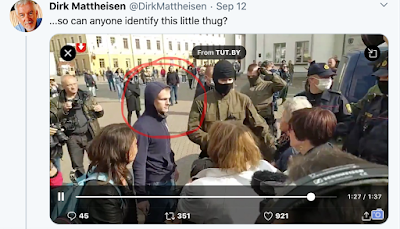
Among the security forces, are men dressed in green uniforms and masks without any identifying insignia. Their anonymity enables them to commit crimes without fear of consequences. However, protestors have begun to rip the masks off the "green men". Social media then makes it possible to identify the individuals, shame them, and hold them responsible for their crimes. Many believe the "green men" are actually Russian security forces brought to Belarus to help Lukashenko suppress the protests.
Also in the street, and closely associated with the "green men", are men dressed as civilians who act with the security forces to suppress the protests. These men seem to have considerable authority. They move about freely with the other security forces and sometimes give orders to the "green men". They haven't gotten as much attention, but exposing who they are will expose a lot about the government's methods. I already drew attention to these actors in my Twitter feed and I am reproducing it below to draw attention to the need to identify who these actors are.
Social media can change the balance of power in favor of the legitimate power of the people. The courageous people of Belarus have shown they deserve nothing less.