Sunday, February 18, 2024

The Military Significance of Avdiivka

Photo credit


Originally posted in Telegram channel Made in Ukraine.


Material from the joint project OBOZ.UA and the Information Resistance group.


Departure from Avdiivka - how will this affect events in the combat zone and what will happen next


The Ukrainian defense forces abandoned Avdiivka, which was quite predictable in the current conditions and for which society should have been prepared without fantasies. This town near Donetsk served as a meat grinder for Russian resources for more than four months, and thanks to this, records for the destruction of DOM were set. But what will happen after the capture of the city and how will events develop in the combat zone?


Record losses


Even Russian military officers and those unit commanders who have the right to vote admit that their losses in the battles for Avdievka are many times greater than during the battles for Bakhmut. While Russian armchair urapatriots are squealing with pleasure at the fact of capturing a small town with an incomplete area of ​​29 km², the middle-level command staff on the ground is horrified by the amount of ROV resource that was allocated for this.


Only according to verified data from various sources, losses in the equipment of the invaders from October 10, 2023 until the end of January 2024 ranged from 400 to 600 units. Taking into account the specifics of verification and coefficients, real losses in equipment in the battle for Avdievka near the ROV could easily reach and even exceed a thousand units! A thousand tanks, armored fighting vehicles, artillery and other equipment in battles for a small town, which is not even a regional or district center and was actually an agglomeration with Donetsk, occupied since 2014!


The loss of human resources among the Russians is completely unimaginable - only the figures of 15, 20 thousand and more are killed.


But the important thing is that since the second half of 2022, the Russian occupiers have not carried out a single important, large-scale seizure of a large city, but are content with small towns and villages. A year has passed since the capture of Bakhmut and now Russian occupation forces are capturing little Avdiivka. But how important was it to them and to us?


The importance of Avdeevka


From the very first days of the attack on this town, Russian propaganda persistently imposed the narrative on consumers of informational fast food that Avdeevka would protect Donetsk from attacks by the Ukrainian Defense Forces, and would also open the road to the Dnieper.


As for the first statement, Avdeevka has never been a platform for firing at Donetsk and its environs. For high-precision strikes against targets of the Russian occupiers, weapons were used that did not need to be in or near the city.


As for the road to the Dnieper, this is partly true, because we are talking about the northern and southern route to Pokrovsk along T0511 and M04, and from Pokrovsk to Pavlograd and Dnieper. But, for a moment, this is 200 km in a straight line. It took the occupiers four months to cover a distance of 1-2 km, break through to Avdiivka and start urban battles, while refusing to advance into the field, and also losing almost a thousand pieces of equipment and tens of thousands of personnel. The question arises: when moving to the Dnieper, what will run out of the ROV first - equipment or people?


In fact, Avdievka was seen by the Russian command as a window of opportunity to show a quick victory on the eve of Putin’s direct line in December, then to the New Year’s address. Now Putin’s address to the federal assembly was heated, and this catalyzed the actions of the ROV into a regime of suicidal assaults.


Avdeevka did not actually represent any tactical, let alone strategic, importance for the Russians. It’s just that the Russian generals decided that they could surround and capture it very quickly. When the failure of the offensive went too far, it was too late to stop...


Read the continuation here 👉 https://war.obozrevatel.com/kovalenko-vyihod-iz-avdeevki-kak-eto-skazhetsya-na-sobyitiyah-v-zone-boevyih-dejstvij-i-chto-budet-dalshe.htm

Saturday, February 10, 2024

The Putin Interview: Distortions, Lies and Misinformation


An excellent, brief counterpoint to the now infamous Tucker Carlson-Putin interview is provided in an article by Stefan Hedlund, professor of Russian Studies at Uppsala University.  

The counterpoint is necessary because, as many have pointed out, the interview is riddled with lies and imagined history.  

Hedlund's article, What President Putin Could Have Learned from History, sets the record straight on Russian and Ukrainian history and their connection.  What it covers is important to keep in mind, while navigating the distortions and outright fabrications on social media.  The basic facts in Hedlund's article are important to keep in mind to avoid being misled.

Among Hedlund's conclusions,

"The final lesson to be drawn from history is that when Ivan the Terrible died in 1584, Muscovy was so exhausted by its drawn-out campaigns to destroy Novgorod and by the Livonian War against Sweden and Poland-Lithuania that it collapsed shortly after...Putin's latter-day Muscovy may be looking at a similar fate...It will find itself increasingly exhausted by its attempt to destroy Ukraine..."

For a longer analysis, read Timothy Snyder's article, Putin's Genocidal Myth on the subtleties of Putin's "naive and cynical" use of history to justify not only Russia's land claims but its genocidal actions in its current war in Ukraine.

For a more detailed history of Ukraine read Paul R. Magocsi's A History of Ukraine: the Land and Its Peoples or Serhii Plokhy's The Gates of Europe.  For an insight into what the Ukrainian people are defending themselves against in Putin's war, read Anne Applebaum's Red Famine: Stalin's War on Ukraine, when up to 4 million Ukrainians may have died in Stalin's 1932-33 manmade famine.

Monday, December 11, 2023

Who's Winning in Ukraine?


Beyond the number of troops, tanks, missles, and military leadership, much of what now happens in Russia's invasion of Ukraine will depend on Vladimir Putin, President of Russia, related to "ideology and political culture on the one hand and political stability and regime legitimacy.", writes Alexander J. Motyl--professor of political science at Rutgers University-Newark and a specialist on Ukraine, Russia and the USSR, on nationalism, revolutions, empires and theory--in an excellent article on what factors are important beyond the military balance between Russia and Ukraine.

What it boils down to is that "...many of Putin’s recent public appearances range from incoherent to embarrassing: They contrast hugely with the self-assured, even arrogant, style of his earlier performances. Today’s Putin is a weak, bloated, and uncertain man who was shocked by Yevgeny Prigozhin’s attempted coup and didn’t know for days how to respond, perhaps because he understood that the run-up to the coup could not have escaped the attention of the secret police, which did nothing to nip it in the bud. Can such a Putin lead a vast country and conduct a war successfully? The question is at least open."

Sunday, November 26, 2023

Putin's Ukrainian Genocide


"Those who are currently calling for a ceasefire in Ukraine must take the genocidal nature of Russia’s invasion into account. Putin has made it perfectly clear that he intends to wipe Ukraine off the map of Europe. He views Ukraine’s very existence as an intolerable threat to Russia itself, and is prepared to pay almost any price to remove this threat by extinguishing Ukrainian statehood. His uncompromising stance is entirely in line with centuries of Russian imperial policy.

Since the start of the full-scale invasion, Putin has demonstrated his willingness to sacrifice Russia’s international standing, along with the lives of hundreds of thousands of Russian soldiers, in pursuit of his messianic objectives. It is dangerously dishonest to suggest he can be appeased with the relatively small portion of Ukraine currently under Russian occupation. In reality, Putin would use any pause in hostilities to rearm and regroup before launching the next stage of his criminal campaign to destroy Ukraine.

Ignoring this imperial agenda will not make it go away. Instead, it is time to acknowledge that today’s invasion is not a conventional war with limited political goals; it is an attempt to complete Stalin’s unfinished genocide of the Ukrainian nation, and it will not end until Russia is defeated."

FROM...

Vladimir Putin is aiming to complete
Joseph Stalin’s unfinished Ukrainian genocide

Putin’s genocidal invasion of Ukraine echoes Soviet dictator Joseph Stalin’s earlier attempt to destroy the Ukrainian nation
by Paul Grod

ADDITIONAL READING...from https://hrsu.weebly.com/holodomor.html

Holodomor

   The term "Holodomor" refers to the mass murder of millions in Ukraine by the method of artificial famine from 1932-33. 
   In 1928, Stalin introduces a program of collectivization of agriculture, aimed at implementing the Communist ideal in real life. This collectivization process requested the farmers from all over the Soviet Union to give up their private land, livestock, and equipment to the state in order to form a large, state-organized factory-like agricultural system, called collective farms. Stalin believed that the collective farms would not only provide enough food for the industrial workers in the cities but also have a surplus for export. Many farmers did not want to give up their private properties, in their last act of resistance, many slaughtered all their livestocks and feasted on the night before they were to be collectivized. So great was the hate and opposition towards the state authorities that the defiant farmers would rather see their livestocks rot and go to waste than for the state to enjoy the advantage of them. 
  In 1929, many Ukrainian farmers still refused to join the collective farms. To crush their resistance, Stalin implemented the new policy of "dekulakization". Kulaks, or kurkuls, as their were known in Ukraine, were affluent or rich farmers. Stalin decided to wage a "class warfare" and liquidate the kulaks as a class. This policy was enforced by the regular army and the secret police (NKVD). Eventually all who opposed collectivization were considered kulaks. 
  In 1930, 1.5 million Ukrainians fell to dekulakization. Close to half a million were deported to gulags or labor camps in the extremities of the Soviet Union. 
  From 1932 to 1933, the Soviet government, in order to teach the Ukrainians “a lesson they would not forget” for resisting collectivization, and to deliver “a crushing blow” to any national aspirations of the Ukrainian people, started the Holodomor. First the government raised the grain production quotas of Ukraine to ensure that they would not be met. Then all grain produced in Ukraine were shipped to other parts of the Soviet Union. In summer, 1932, a decree called for the arrest or execution of any person found to be stealing or hiding grain from the fields in Ukraine, even a child for taking as much as a few wheat stalks. Military blockades were erected around villages to ensure no grain is smuggled in to feed the villagers or the starving villagers from leaving in search of food. Brigades of young activists were brought in from over the country to sweep the villages to search for any hidden grain. Thus, though grain production is actually increasing in Ukraine for the past years, an artificial famine is staged to starve millions to death. 
  In 1933, at the height of the artificial famine, the death rate was as high as 30, 000 a day. It is estimated that 7 million deaths occurred from Holodomor in 2 years, as compared to 6 million deaths from the Holocaust by the Nazis over a number of years. 
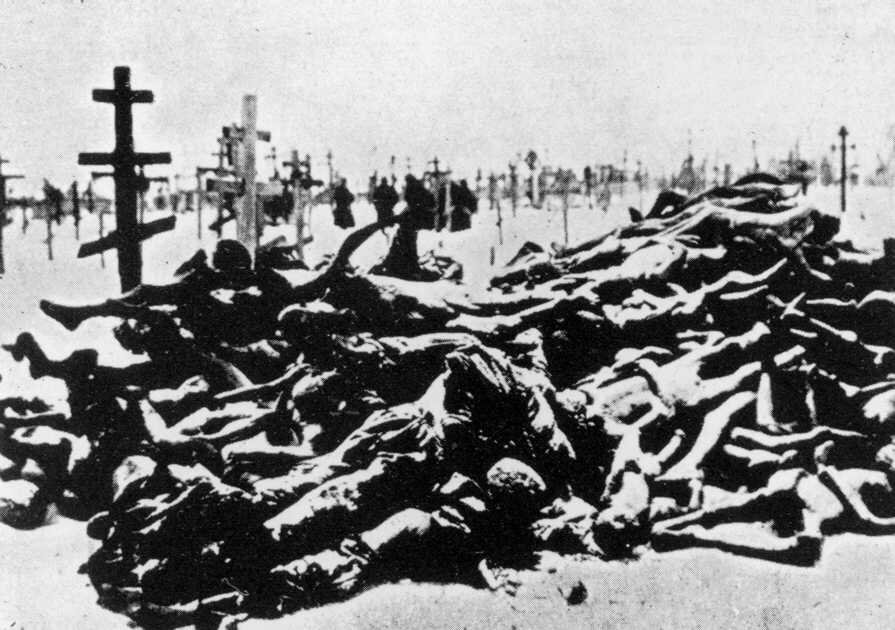
Picture
Bodies of the victims of Holodomor

Significance of Holodomor

  During Holodomor, the Soviet government denied famine and this was echoed by prominent Western journalists at the time, such as Walter Duranty. The Holodomor was not globally recognized until the late 1980s, when scholar on Soviet history Robert Conquest published a book named "Harvest of Sorrow". Holodomor is recognized as an act of genocide even though the Russian government still denies it to this day.

Wednesday, November 15, 2023

The Little Cracks in Russian Society will swell to Become a Greater Threat To Russia than Defeat in Ukraine

 From bne Intellinews...

Appalling from Russian society's point of view, is how far Putin is prepared to go to corrode Russian society in order to pursue grandiose imperialistic dreams.  That corrosion is apparent in countless small events in Russia that are becoming increasingly frequent.

As bne Intellinews writes briefly below, "one of those very unpleasant and frankly scary Russian stories" is Putin's pardon of Politkovskaya’s killer.

These little events will accumulate and eventually cause the collapse of Russian society.  Russia's defeat in Ukraine will be nothing compared to its self-inflicted defeat within Russia itself.

Logo
bne IntelliNews Editor's Picks --  Putin pardons Putin pardons Politkovskaya's killer

Putin pardons Politkovskaya’s killer

This is one of those very unpleasant and frankly scary Russian stories. Russian President Vladimir Putin has pardoned a Chechen, who was jailed for participation in the murder of famous human rights journalist Anna Politkovskaya.

She was gunned down in 2006 in front of her front door on Putin’s birthday in probably the most high-profile slaying of an opposition journalist. She worked for Novaya Gazeta, a leading liberal newspaper that has seen several of its staff killed.

She was also a vocal critic of Chechen President Ramzan Kadyrov and accused him of human rights abuses of which he is almost certainly guilty. And she died as a result. Indeed, there are a string of corpses in Kadyrov’s wake. Kadyrov has also been linked to the death of opposition leader Boris Nemtsov in 2015 and also a Chechen who was gunned down in a park here in Berlin in 2021. Many of the high profile murders in Russia seem to be connected to the Chechen strongman.

It is clear that Putin doesn’t have full control of him as he keeps shooting people he doesn’t like with impunity. For example, recently his son was filmed beating a man that disrespected Islam – and nothing happened to him.

This is the problem of adopting the “power vertical” as your political model, rather than broad-based democracy: you become hostage to some of your underlings. Putin can’t do anything about Kadyrov as he is holding the lid on a third insurrection in Chechnya, making Putin powerless as there is no way he will send troops there for a third time.

And if Kadyrov goes there is a good chance it will rise up again. There were rumours that Kadyrov had died last month (and he does look unwell, he has gained a lot of weight recently), but he survived whatever was wrong with him. There are also reports that his son was sent to Moscow and had a long interview with Putin. It’s widely assumed that Kadyrov is getting ready to retire and intends his son to take over.

Monday, June 19, 2023

How Geography Explains Russian Colonialism


A bit of history and geography to explain Russian colonialism, courtesy of Volodymyr Kukharenko.

And why Ukrainians are different than Russians:

“This is the soil fertility map. Most of European best soil is located in Ukraine, and also in Russia. The Russian fertile lands are actually those taken from other nations in conquests, even now a great part of the population there are Caucasian and Turkic nations, and some regions were populated by ethnic Ukrainians in the past. “Original” Moskowia did not have such lands when it started its conquests. 

“This is the answer to many questions. People that lived on the territory of Ukraine were farmers for thousands of years. This land could feed so many people that in pre-industrial times when agriculture was the main pillar of the economy Ukraine was one of the most populated lands in the world. This is why Persia, Alexander the Great, and the Romans could not take it. This is why in 1100 Kyiv was 4th largest city in Europe while Moskow was not yet founded. This is why people were always ready to defend their land because it gave them life and prosperity. Ukraine never had natural famines. And 48% of the world population now speaks Indo-European languages that started from the area which is now mostly Ukraine and Romania

“Moskovites (Merya tribe) were nomads and started farming only in 7th century at the earliest. The first metal tools found in their area are daring back only 2000 years ago, and most likely they started making their own metal tools 1500 years ago. So they just exited the stone age at the time when Kyiv was founded. And they did not have time to develop new agricultural traditions and culture, so they just tried to adapt their nomadic ways to new reality. And nomads do not need to develop own lands, they just use it, and also loot the farmers. A farmer can feed himself alone, a nomad needs a strong leader to survive. Farmers may fight with each other, to get more land and develop it. Nomads would just raid and rob, without investing in the development. And it does not matter that now the descendant of farmers and nomads are living in the 21st century, the habits remain even after the centuries. Russia now raids and robs Ukraine, and Moskow robs the provinces inside of Russia.

“Times have changed, and now the economy is defined not only by agriculture. But Ukraine feeds 10 times more people than its own population. Most of the Ukrainian crops go to North Africa and Asia. And if people there start starving, they will flock into European Union trying to save themselves. So the longer Russians are in Ukraine, the more people in Africa and Europe will suffer. And now, after they have destroyed the Kakhovka dam and ruined the irrigation in southern Ukraine, the food price will go up, as with the reduction of Ukrainian supplies.