Friday, July 15, 2022

Latest OSCE Report on Russian Atrocities in Ukraine Reflects a Greater Illness in Russian Society


photo credit

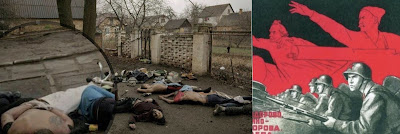
In my last posts, I wrote that Russian culture accepts murder, torture, rape, and pillaging carried out by Russian soldiers in Ukraine.  A behavior, I argue, that has its basis in Russian society where citizens are complicit because they accept what the brutal, authoritarian Russian state is condoning.

Russian soldiers did't become brutal when they crossed the border into Ukraine.  They brought their brutality with them from a society that has been brutalized itself over many decades and centuries.

The latest OSCE report provides abundant confirmation of this.

The Kyiv Independent reports that the latest OSCE report "...details violent acts committed by Russian soldiers in Ukraine between April 1 and June 25.  The report noted several particularly brutal cases, including rape and gang rape of children in front of family members, summary executions, and torture of civilians in torture chambers, all of which constitute crimes against humanity."

The OSCE report covers instances of humanitarian crimes on both sides, but the evidence of Russian crimes is huge and systematic.  Page after page reports "Russian soldiers beat, shocked, or staged mock executions to force detainees to provide information; in "a village in the Bucha district, 18 mutilated bodies of murdered men, women, and children were discovered in a basement: some had their ears cut off, while others had their teeth pulled out."

The OSCE reports hundreds of "enforced disappearances" and thousands of involuntary deportations, including 2,200 children in the first three months of the war,

"Ukraine's Commission for human rights said in mid-May that Russia had relocated more than 210,000 children during the conflict, part of the more than 1.2 million Ukrainians deported against their will, according to Kyiv." The OSCE reports "...when Russian forces controlled much of the Kyiv and Chernihiv regions in northeastern Ukraine, they subjected civilians to summary executions, torture, and other grave abuses, all of which amount to war crimes."

Crimes against personal property are so absurd as to be comic.  The OSCE reports,

"Survivors of the Bucha massacre have claimed that Russian soldiers ransacked the city, taking jewellery, electronics, kitchen appliances, clothes, and vehicles from the displaced, deceased, and those still in the city...Similarly, in the village of Berestyanka near Kyiv Russian soldiers looted clothing, appliances, and electronics from homes before the village was returned to Ukrainian control. Belaruski Gayun, a Telegram channel that has been monitoring military activity in Belarus since February, reported in early April that Russian soldiers were sending large packages to Russia via a courier service. The packages are believed to contain items stolen by Russian soldiers. There have been reports of Russian forces setting up bazaars in Belarus to trade looted goods. Washing machines, dishwashers, refrigerators, jewellery, automobiles, bicycles, motorcycles, dishes, carpets, works of art, children's toys, and cosmetics are examples of such items"

There are many ways to look at the horrific behavior of Russian soldiers, but perhaps the most instructive is that many of the most horrific acts were carried out in the early days of the war when Russian soldiers believed they would overwhelm Ukrainian defenders and have complete control of Ukraine, not when they were under the continued stress of losing ground.  At that time, they clearly felt they had free reign to commit any act of violence and not be held accountable, an indication of the values they held when they entered Ukraine.

It was not just individual soldiers.  Russian soldiers throughout Ukraine believed they had license to carry out any atrocity.  The OSCE reports that "Instances of torture and inhuman or degrading treatment have been reported from all territories which were or have been temporarily occupied by the Russian armed forces."

That Russian state-sanctioned crimes were institutionalized is also evident from the many crimes that the OSCE reports took place in the Russian filtration camps.  The OSCE reports "a relatively consistent pattern of behaviour on the side of the Russian Federation, when the military occupation of a certain area is followed by abductions, interrogations, mistreatment and sometimes killings of important public figures, such as mayors or local journalists."

The reading of the OSCE report can be quite brutal.  The OSCE states "Reports from and about women being raped or otherwise sexually abused by members of the Russian armed forces, especially in the newly occupied territories, have become abundant...It is generally believed that the actual number is much higher and that many incidents of rape and sexual-based violence simply fail to be reported.  It is alleged that “the Russian Federation is using sexual violence and rape as instruments of terror to control civilians”

It just gets more horrific.  The OSCE report continues, "There are also certain reports indicating instances of gang rape or rape carried out in front of family members, including children."

Remember, these are evidently Russian state-sanctioned acts.

In one paragraph the OSCE reports:

"Reports of sexual violence against children, including rape, have been particularly common, though the extent of this violence is difficult to assess due to the sensitive nature of the abuse, the well-known and well-understandable reluctance of victims to report it and misinformation about this issue spread in the public space. By 3 June 2022, the UN Human Rights Monitoring Mission in Ukraine received 124 allegations of conflict-related sexual violence, 97 of them involving women and girls, 19 men, seven boys and one gender unknown.  After the Russian armed forces were pushed out of the areas north of Kharkiv, the Commissioner for Human Rights Denisova stated that a one-year-old boy was raped by Russian soldiers and later died in a village near Kharkiv.  Other victims have been reported, including "two 10-year-old boys,triplets aged 9, a 2-year-old girl raped by two Russian soldiers, and a 9-month-old baby" raped in front of his mother”

The Russian government's response?   The OSCE reports, "that instead of conducting investigation into the allegations of serious crimes, the Russian Federation simply denies these allegations and, in one instance at least, even confers special honours on members of the Russian armed forces who are suspected of having engaged in mistreatment and extrajudicial killings of civilians."

It is difficult to absorb the full impact of what the OSCE writes.  It is too extreme.  It is too horrific.  That Russian soldiers feel entitled to carry out atrocities and that the conduct of the war--including institutional support for abductions, deportations, torture, murders and unspeakable brutality--is tolerated by the Russian state, reflects a societal belief that these atrocities are acceptable behavior.  The Russian war on Ukraine may not end until Putin dies, but Russian aggression and barbaric behavior will only end when Russian society's acceptance of barbaric behavior ends.

Russia won't change until this is unacceptable:


Friday, June 24, 2022

Russia in Ukraine: A Google Poem


A Google Poem of Russian Barbarism in Ukraine

Google Поэма о Russkoye varvarstvo на Украине


You are not your grandparents’ or great grandparents’ grand children.

Вы не великий внуки своих бабушек и дедушек или прабабушек и прадедушек


You are not heroes of a Great Patriotic War.

Вы не герои Великой Отечественной войны


(Nor were those who killed fellow Russians with whom they  

lived and fought. Comrades, brothers and sisters.

(не многие из них убивали Других Русских с кем жили и воевали как Товарищи, братья и сестры


Who pillaged and raped across Poland and Germany.)

И с кем грабили и насиловали по всей Польше и Германии)


In Ukraine,

На Украине


You are pillagers.

Вы грабители


Common thieves.

Обычные воры


Murderers Torturers Rapists Kidnappers Child-molesters Destroyers of families and homes.

Насильники, убийцы, стрелятели в малолетних, мучители, похитители, разрушители семей и домов


In Bucha and Mariupol.

В Буче и Мариопуле


There is no Great because there is no glory in barbarism.

Нет Великого, потому что нет славы, живущей с варварством


Curse with your wives. Curse with your mothers. Curse your commanders.

Матюкаетесь с своими женами, матюкаетесь с своими матерями, матюкаетесь на своих командиров


You cursed yourselves. Condemned in memory not just yourselves but Russia’s next generations.

Вы прокляли себя, Осуждены в памяти не только своей, но и следующих поколений России


Russia will weep not for you but for what you have done.

Россия будет плакать не о вас, а о том, что вы сделали


Friday, June 17, 2022

Empty chairs in St. Petersburg reflect the hollowness of Putin's message

A lot of empty chairs in St. Petersburg
Photo Credit

President Putin excoriated the West, the US in particular, at the annual St. Petersburg International Economic Forum on Friday (June 17) (well, international, not so much as high profilers from past years avoided the event like the plague.  Putin continues to attack Ukrainian sovereignty and has recently claimed that in attacking Ukraine, Russia is merely reclaiming its historic lands, which, by the way, include the Baltics states and Poland.  Back in April, I had written "...who can say that Putin, the new Czar, without checks on his behavior from an independent civil society, did not imagine a new Livonian war, the conquest of Poland and the Baltics after Ukraine."  Putin at the St. Petersburg forum is the Czar unleashed.  He declared the US a declining power with a collapsing economy and diminishing influence around the globe.  Much of what he said was shrill, emotional, and not a little panicky.

Where this leaves Russia is hard to say.  Russia's military power is being savaged in Ukraine, exposing its weakness as a global--or even regional--power.  While unprecedented sanctions have not collapsed the Russian economy, the cost of its invasion of Ukraine is a huge burden to its economy that will continue into the indefinite future as the cost of holding conquered territory will be equally as high as conquering it. Meanwhile, the limits on trade with the West will slowly erode Russia's economic growth in absolute terms and relative to other, faster-growing economies.  If Putin is right that a new world order is emerging, Russia is unlikely to be a major military or economic power in that new world.

With military and economic decline, Russian society will be under immense strain.  Russian soldiers in Ukraine, as a reflection of contemporary Russian society "...today brutalize, rape, murder, and shit where they tread."  I had written also that "Russian civil society has not dealt with the ineptitude, corruption, and brutality of authoritarian government in Russia’s recent history", which undermines social cohesion every bit as much as economic decline...Putin has had it easy because Russian society is unreconciled to its past, which makes it susceptible to the strongman promises of order and security.  Russian society is fragile because it has never experienced a catharsis of truth and, therefore, underestimates the high cost of an authoritarian government.  Russia needs what other societies have experienced, a truthful accounting of the past in order to build a proper relationship between society and the state where society legitimates state policy rather than accepting dictates by the state.

What Russian society does not need is more lies from Putin.


Tuesday, May 10, 2022

Putin's Illusions About Ukraine and Historic Truths

 In Moscow on May 9 in his speech on the anniversary of the Great Patriotic War (WWII) Putin again accused Ukraine and the West of aggression against Russia.  He accused the West of plotting invasion and Ukraine of being a Nazi-ruled state.  Putin declared that "...there is no place in the world for executioners, punishers and Nazis."  In recent remarks, Putin has denied the historic existence of Ukraine as a nation and the Ukrainians as a separate and distinct people and culture.

While Putin did not announce any new initiatives or escalation of the war as many anticipated, the Russian army and various informal auxiliaries, such as Wagner and Syrian mercenaries, continue to occupy and assault Ukrainian villages and cities while attempting to degrade the Ukrainian military that it is unable to defeat.

In effectively a counterpoint to Putin's rants, Andrei Kozyrev, former Russian Minister of Foreign Affairs and author of The Firebird: The Elusive Fate of Russian Democracy, writing in the Financial Times (May 7/8) recalls that while he was growing up Russians and Ukrainians were called "brothers and sisters".  They fought Germany together, "suffering gravely and contributing decisively to a final victory.”

More poignantly, Kozyrev recalls that "When the Soviet Union collapsed in 1991, about 90 percent of Ukrainians, including majorities in Crimea and Donbas, voted for independence in a referendum.  I was proud to be a member of the Russian Federation government that honoured that choice."

Kozyrev describes Putin's annexation of Crimea and invasion of eastern Ukraine as a "brazen violation of Russia's obligation s under the Budapest memorandum" and he regrets the inadequate response of America and Europe.

And regarding Putin's May 9 speech where Putin accuses Ukrainians of being Nazis, Kozyrev remarks, "Putin has in fact established a connection with the Nazis--but through his own deeds, not by slandering Kyiv."

Putin's May 9 speech is a fantasy.  His lies are as transparent to Russians as they are to everyone else.  But, ultimately, reality corrects for falsehoods and gravitates to truth.


Monday, May 2, 2022

Ukraine is not Russia - and never has been


Photo Credit

Many outside Ukraine and Russia view Ukraine and Russia and their peoples as largely the same.

However, the current war is, in fact, a war between two cultures or societies.

The reason for the confusion is that in modern times imperial Russia captured and attempted to colonize Ukraine.  Ukraine only managed to break free in 1991.

But the difference between the two has been recognized for as long as the two have existed, even while Ukraine was a part of a Russian empire.

For example, in 1861 the Russian historian, Mykola Kostomarov, wrote this about the difference between Ukrainians and Russians, 

(Source: Paul Robert Magocsi's A History of Ukraine; The Land and Its Peoples)

"The Southern Rus' [Ukrainians] are characterized by individualism, the Great Rus' [Russians] by collectivism...In the political sphere, the Southern Rus' people were able to create among themselves free forms of society which were controlled no more than was required for their very existence, and yet they were strong in themselves without infringing on personal liberties.  The Great Rus' people attempted to build on a firm foundation a collective structure permeated by one spirit.  The striving of the Southern Rus' was towards federation, that of the Great Rus' towards autocracy and a firm monarchy."

Despite the archaic and russo-centric reference of his time to a "Southern" and a "Great" Rus', Kostomov distinguished between the two as having distinctly different cultures.  Although an imperialist who believed in a federated Slavic civilization, he was also a leading figure in the Ukrainian national movement that recognized a distinct Ukrainian culture--not a Putinist at all.

Ukrainians' individualism and love of freedom stand in contrast to Russians' autocratic culture.  Ukrainians are not just a separate nation, they are a separate Slavic people with a distinct culture from that of Russia. 

Sunday, May 1, 2022

A Rational and Deeply Hoped for Humanitarian Moment in Ukraine

Two months cut off and under constant Russian bombardment, these children and others are now being evacuated under UN umbrella from Mariupol'.

Meanwhile, attention to Russian war crimes gains momentum.  Here is a podcast on the legal dimensions of prosecuting war crimes, including genocide.

https://www.economist.com/podcasts/2022/04/28/will-russian-war-criminals-face-justice


Friday, April 22, 2022

Russian Civil Society At War


One consequence of Russia's war on Ukraine may turn out to be a long-overdue self-examination of Russian society's acceptance of brutal crimes against humanity.

In discussing the lack of more vigorous anti-war protest in Russia and civil society's support for Russia's war on Ukraine (Is Russian Civil Society Dead?)--despite the barbaric conduct of Russia's military--I had written that Russians' readiness to lie and to be lied to is symptomatic of acquiescence and avoidance. That,

"The real problem is Russian society’s fragility–the flipside of a belligerent Russia–due to a lack of social institutions that protect the individual; that belligerence is Russian society’s impotent rage at their awareness that the world is not what they are told and they are not who they believe themselves to be."

Individual Russians are confronting that same fragility in Russian society as they watch the barbarism of the Russian military unfold in Ukraine.

Andrei Kolesnikov, a senior fellow at the Carnegie Endowment for International Peace, in Foreign Affairs (Putin's Aggression Has Turned a Nation Against Itself), writes,

"Today, the dominant response of ordinary Russians to the war is aggression. It is undergirded by what seems to be an almost subconscious effort to block out any bad news, and with it, any sense that the nation might be in the wrong. Fear of authority not only prevents people from protesting against a barbaric war; it also makes them unable to admit even to themselves that Putin’s Russia has committed something dreadful. It is frightening to be on the side of evil."

And, Natalia Sindeyeva, former head of Russian independent media TVRain, in an interview with the Financial Times (FT's interview: Russia's Unlikely Media Revolutionary), "thinks the problem has deeper roots in Russia's failure to hold a truth and reconciliation process in the way Germany did after the second world war...'We didn't get together as a country, as a society, to recognise the mistakes that were made.  It all went unsaid.''

..."It's not just collective guilt but collective complicity.  What Putin's done is smear everyone, so you become part of it even without doing anything."  She describes a"cognitive dissonance" of complicity; "You can't imagine that your government, which you believed in, could have done something like that.  You start convincing yourself and everyone around you that it's all lies and you know the truth..."At some point you have to convince yourself, because otherwise you just lose your mind."

Russia has launched a war without a rationale.  A war that is simply an eruption of violence.  As a consequence, Russian society is racing toward an abyss of self-recognition of its own complicity.